
Budgeting for Excellence: Catering in Education

Delivering high-quality food in schools has never been more complex. Education caterers are expected to meet strict nutritional standards, appeal to increasingly discerning young audiences and support wellbeing – all while operating within some of the tightest financial constraints in the sector. Achieving excellence under these conditions requires a thoughtful, strategic approach to budget school catering, where every decision is designed to balance cost, quality and long-term value.

In today’s education environment, budgeting is not simply about reducing spend. It’s about understanding where investment matters most, planning menus intelligently and empowering catering teams to work creatively within financial frameworks that are often under pressure.

Making smarter choices with limited resources

One of the defining challenges of budget school catering is managing rising costs across food, energy and labour, while funding levels remain largely fixed. This places significant responsibility on catering teams to plan menus that are both cost-effective and nutritionally robust.

Seasonal menu planning plays a vital role here. By building dishes around ingredients that are readily available and at their best, caterers can control costs while improving flavour and quality. Careful supplier partnerships, waste reduction strategies and forward planning all contribute to stretching budgets further – without compromising the meal experience for students.

This approach reinforces a key principle: value and quality are not opposites. With the right planning and expertise, simple ingredients can be transformed into meals that are appealing, nutritious and satisfying.

Expertise that drives excellence

Few people understand the realities of education catering better than Jennifer Brown, 2024 LACA School Chef of the Year. Her recognition reflects not only culinary skill, but an exceptional ability to deliver high standards within the financial pressures schools face every day.

Jennifer believes that success in budget school catering starts with people, not price points:

Great school food doesn’t start with a spreadsheet – it starts with skilled, confident teams who understand how to plan, cook and adapt. When chefs are properly supported, they can deliver nutritious, appealing meals while still working within very real budget constraints.

Her insight highlights a crucial truth across the sector: budgeting works best when it enables capability rather than restricting creativity.
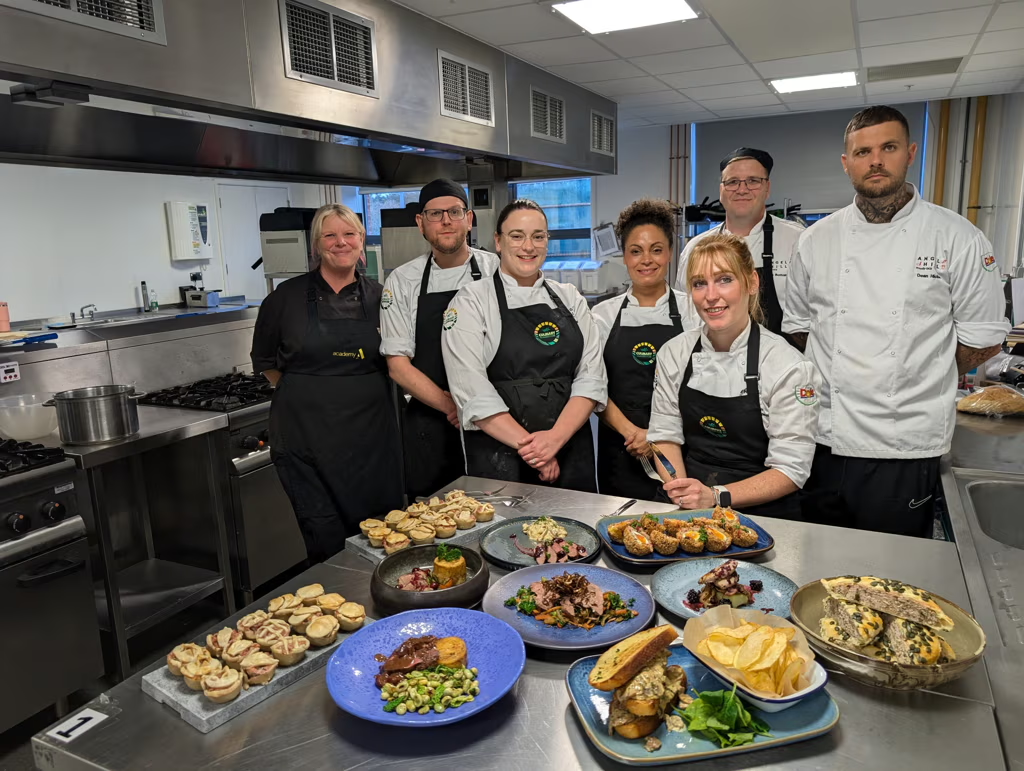
Jennifer Brown teaching the Culinary Classroom 24/25 cohort how to cook with underutilised British produce.

Investing in skills, not just systems

Training and development play a critical role in helping catering teams work effectively within tight budgets. When chefs are confident in portion control, ingredient utilisation and menu planning, they are far better equipped to reduce waste and maintain consistency – both of which directly protect margins.

Skilled teams can make thoughtful decisions about how ingredients are used across menus, ensuring that value is maximised without compromising quality. This not only improves financial performance but also boosts morale and pride in the food being served.

For many schools, investing in people is one of the most impactful ways to improve outcomes in budget school catering – creating kitchens that are resilient, adaptable and focused on continuous improvement.

Beyond the plate: the wider role of school catering

School catering has an influence that extends far beyond lunchtime. For many pupils, school meals provide the most balanced nutrition they receive in a day, making the role of caterers central to health, wellbeing and educational performance.

As a result, budget decisions carry long-term implications. Thoughtful planning can unlock wider benefits – from supporting food education and engagement to strengthening community connections through inclusive meal programmes.

Rather than limiting ambition, effective budgeting can act as a catalyst for smarter, more meaningful food provision.

Planning for a sustainable future

As costs continue to rise, the challenge for education catering will remain complex. Meeting it requires collaboration across schools, caterers and policymakers – alongside funding models that better reflect the true cost of delivering nutritious, high-quality meals.

In the meantime, the focus remains clear: skilled teams, smart planning and purposeful investment. When these elements come together, budget school catering can deliver far more than compliance – it can deliver excellence.

By treating budgets as a strategic tool rather than a limitation, education caterers can continue to serve food that nourishes bodies, supports learning and makes a lasting difference in young people’s lives.

Big Carbon Kick Out: A Conversation with Matt Vernon

As pressure mounts on the food and hospitality sector to reduce environmental impact, the role of catering has never been more critical. Food sits at the intersection of sustainability, nutrition and human behaviour – and change at scale can only happen if solutions are practical, appealing and commercially viable.

Big Carbon Kick Out was created to address exactly that challenge. Rather than asking customers to change what they eat, the initiative focuses on rethinking how familiar, high-volume dishes are made – delivering meaningful carbon reduction without compromising on flavour, nutrition or experience.

We sat down with Matt Vernon, Executive Development Chef, to explore the thinking behind Big Carbon Kick Out, the data driving decisions, and why small changes applied consistently can deliver industry-level impact.

Matt, what problem was Big Carbon Kick Out designed to solve?

Matt Vernon:

We were seeing a real gap between sustainability ambition and what actually works in catering environments. There’s a lot of pressure to ‘do something green’, but often that results in niche menus or bolt-on initiatives that don’t scale.

Big Carbon Kick Out was designed to close that gap. Instead of asking customers to change their behaviour, we focused on changing the food itself – improving the dishes people already choose every day. That’s where scale, and therefore real impact, comes from.

Why was it important to focus on everyday dishes?

Matt Vernon:

Familiarity drives uptake. If you want carbon reduction to work at scale, you have to work with human behaviour, not against it.

When people recognise a dish and trust it, they order it without hesitation. That gives us an opportunity to reduce carbon quietly and consistently, without turning sustainability into a barrier or a ‘worthy choice’. The customer just experiences good food – and the impact happens in the background.

How did nutrition and data shape the development process?

Matt Vernon:

Nutrition was central from day one. We worked very closely with our nutrition team to ensure that any carbon reduction didn’t come at the expense of nutritional balance.

A lot of carbon impact sits in meat and dairy, so we focused on where those ingredients could be reduced or rebalanced responsibly. That doesn’t mean removing protein or satisfaction – it means rebuilding dishes intelligently using pulses, vegetables and technique to deliver the same experience in a lower-carbon way.

Can you share a clear example of the impact this approach delivers?

Matt Vernon:

Lasagna is one of the best examples because it’s a classic, high-volume dish. By reducing animal products by around 30% in our lasagna recipe, we saved approximately 162 kilos of carbon emissions per 100 portions.

To put that into perspective, that’s the equivalent of driving a petrol-powered car from London to Milan – from a single recipe change. When you apply that level of thinking across multiple everyday dishes, the cumulative impact becomes genuinely significant.

What has Big Carbon Kick Out achieved so far at scale?

Matt Vernon:

So far, we’ve served more than 3,000 Big Carbon Kick Out dishes, resulting in a saving of around 3,724 kg of CO₂e. That’s roughly the equivalent of driving over 9,500 miles in a petrol-powered car.

What’s important is that this impact hasn’t come from one big intervention. It’s come from lots of small, smart changes applied consistently. That’s the model we believe in – because it’s sustainable operationally as well as environmentally.

How are chefs responding to this way of working?

Matt Vernon:

Really positively. Big Carbon Kick Out respects the craft of cooking. It challenges chefs to think differently about ingredients and technique, but it doesn’t limit creativity or strip dishes back.

Once chefs see that customers still enjoy the food – sometimes even more – confidence grows quickly. It becomes something they feel proud of, not something they feel restricted by.

And how does this land with customers?

Matt Vernon:

That’s the real test – and it’s where the initiative has been most successful. Customers aren’t being asked to make a conscious ‘green choice’. They’re simply enjoying food that tastes great and feels familiar.

Sustainability becomes effortless. There’s no compromise, no lecture, no sense of loss – just better food with a lower footprint.

Looking ahead, what’s the next evolution of Big Carbon Kick Out?

Matt Vernon:

We’re continuing to expand the programme through new recipes, ingredient innovation and supplier partnerships. In some cases, we’re exploring ways to reduce animal products by up to 50%, while still delivering flavour, nutrition and satisfaction.

The ambition is for Big Carbon Kick Out to become a normal way of thinking about food – not a campaign, but a long-term framework for responsible, flavour-first catering.

From Initiative to Mindset

Big Carbon Kick Out demonstrates that carbon reduction in catering doesn’t have to be disruptive or restrictive. By focusing on everyday dishes, grounding decisions in nutrition and data, and empowering chefs to innovate within familiar formats, Angel Hill Food Co. is showing how sustainability can be embedded into daily operations – quietly, confidently and at scale.

For the wider catering industry, the message is clear: real change doesn’t always come from radical reinvention. Often, it comes from doing the basics better, more thoughtfully, and more consistently.

And when that happens, the impact speaks for itself.